Table of contents
Behind the fast rollout of modular EV charging hubs, a quieter bottleneck is taking shape inside the cabinets: power distribution. As utilities tighten interconnection rules, and operators chase uptime targets that resemble data centers more than gas stations, electrical panels are becoming a strategic component rather than a commodity. The choices made in switchboards, busbars, protection, and monitoring now dictate how quickly sites can scale, how safely they can run at high load, and how easily they can be serviced when something fails.
Charging hubs scale, panels feel the strain
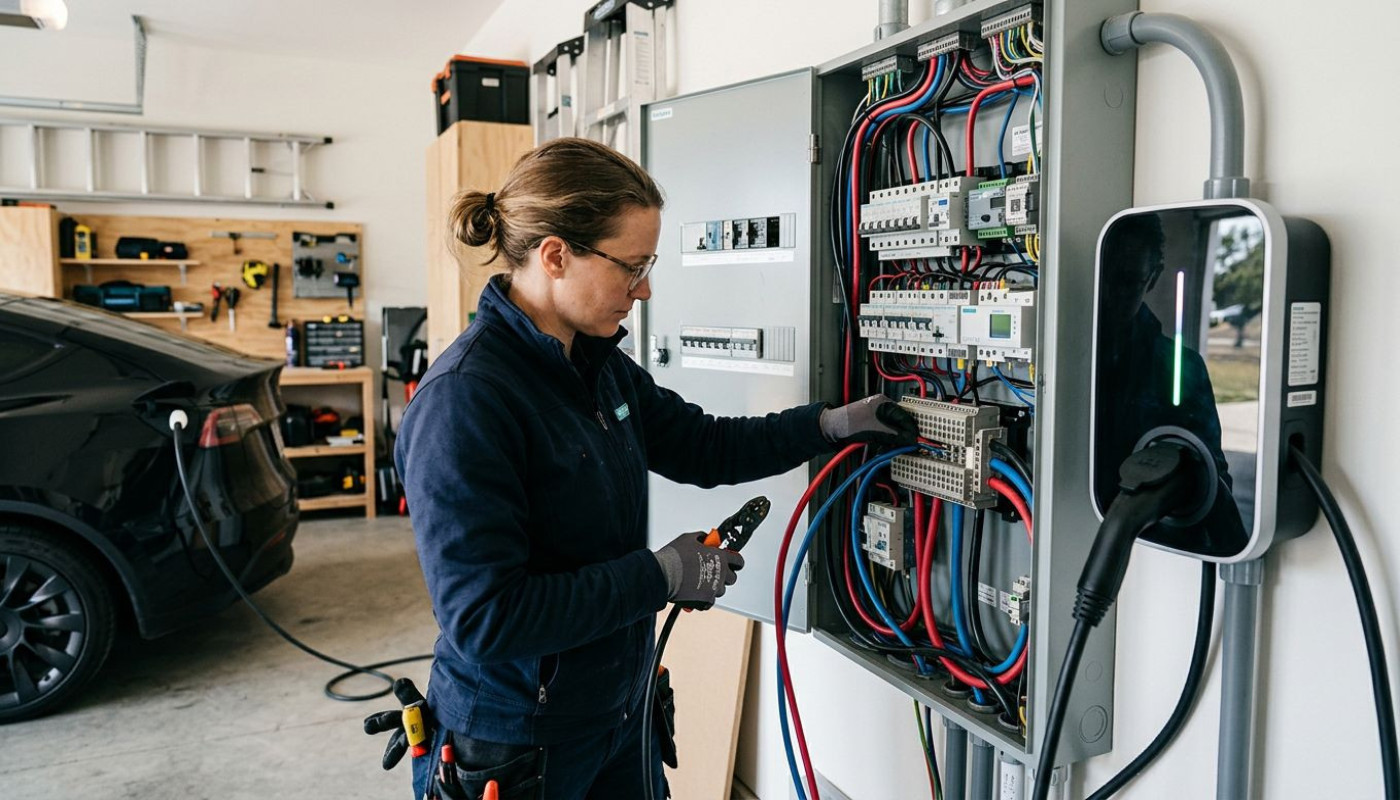
One failed component can turn a “high-power” hub into a row of idle pedestals, and that reality is pushing engineers to scrutinize electrical panels with a level of attention once reserved for transformers and chargers. The reason is straightforward: modular charging sites are no longer a couple of 22 kW points tucked behind a supermarket, they are increasingly designed as expandable clusters with 150 kW to 400 kW dispensers, shared power cabinets, and future-ready footprints that plan for more stalls as EV adoption rises.
That growth profile multiplies stress inside distribution boards. Higher continuous currents mean more heat, tighter derating margins, and a greater need for robust copper architecture, ventilation strategy, and protection coordination. According to the International Energy Agency, global public charging capacity rose sharply in recent years, with fast chargers increasing faster than slow ones, a trend that concentrates power on fewer sites and raises the stakes for distribution design. When a hub targets megawatt-class aggregate capacity, the panel is no longer “just” an enclosure; it becomes the operational spine that must carry load safely, limit fault energy, and enable technicians to isolate problems without shutting down the whole site.
Modularity adds another twist: operators want to deploy in phases, connect to the grid as early as possible, and upgrade later as utilization grows. That calls for panels designed for staged expansion, with spare ways, clear segregation, and a topology that can accept new feeders and measurement points without rewiring the entire cabinet. The economics are compelling, but the execution is difficult, because every late-stage modification introduces risk: arc-flash exposure, improper torqueing, mismatched protection settings, and inadvertent downtime. In that context, panel engineering becomes a forecast of whether a site will be a reliable asset, or a maintenance headache disguised as infrastructure.
Safety rules move from paper to hardware
Safety is where glossy renderings meet physical reality, and electrical panels are increasingly the place where compliance either holds or breaks. As charging hubs grow in power density, they must contend with higher prospective short-circuit currents, more complex selectivity requirements, and stricter expectations on protective devices, earthing, and segregation. The panel is where these decisions are embodied: breaker technology and ratings, coordination studies, cable management, IP protection, and clear labeling that supports safe work under pressure.
Europe’s regulatory environment adds layers of rigor, from low-voltage directive obligations to installation standards that shape how switchgear is assembled, tested, and documented. Even when the charger itself is certified, the hub’s overall risk profile depends on the quality of the distribution assembly, including routine tests, dielectric verification, and thermal considerations that are easy to underestimate in compact enclosures. High utilization sites run hot, and heat accelerates aging in connections and insulating materials, which is why the “small” decisions, such as busbar spacing, plating, torque procedures, and the quality of terminations, become decisive over a multi-year operating life.
Then there is the human factor. Charging hubs are often located in places where maintenance windows are short, weather is poor, and technicians may be working with multiple subcontractors and mixed documentation. Clear panel architecture, safe isolation points, and unambiguous circuits reduce the chance of errors. In practical terms, modern hubs increasingly borrow from industrial practices: compartmentalization, interlocks, dedicated sections for auxiliary power, and thoughtful separation between control and power wiring. It is also why many operators now favor industrial-grade assemblies and partners with deep electromechanical experience, including manufacturers such as Aventech Industrial electromechanical equipments manufacturer, whose core competence sits precisely in the parts of the system that determine whether safety is achieved in the field, not merely claimed on a datasheet.
Remote monitoring turns panels into data sources
Uptime is the headline metric, but it is won in the details. As public charging becomes a service business, operators are pressured to deliver reliability that matches consumer expectations, and that means diagnosing faults fast, sometimes before drivers notice a problem. Electrical panels are evolving into data-rich nodes, capturing measurements that go beyond basic kWh billing: per-feeder currents, temperature at critical points, breaker status, power quality indicators, and alarms tied to ventilation or door access.
This instrumentation supports a shift from reactive maintenance, where a site is fixed after it fails, to predictive approaches that look for early signals: rising resistance at a joint, unusual harmonics that stress equipment, or repeated breaker trips that hint at a downstream issue. The value is operational and financial. A hub with multiple dispensers can lose significant daily revenue from a single unresolved fault, and reputational damage compounds when drivers reroute or post negative feedback. By contrast, a panel that integrates smart metering and clear segmentation helps teams localize the problem to a feeder, a power module, or an auxiliary circuit, and dispatch the right part and technician on the first visit.
Grid interaction is also becoming more complex. Many hubs now include on-site storage, solar canopies, or dynamic load management, and each layer adds measurement and control requirements. Panels become the place where these systems converge: ensuring that protective devices coordinate across inverter sources, that backfeed conditions are accounted for, and that control wiring is robust against electromagnetic noise. Even without onsite generation, utilities are increasingly sensitive to power quality, and high-power chargers can introduce harmonics and rapid load changes that must be managed. A well-designed distribution assembly can integrate filtering strategies, monitoring, and clear interfaces for energy management systems, turning the panel into a tool for grid-friendly operation rather than an afterthought tucked behind a locked door.
What “modular” really demands from design
Modularity sounds like speed, but it also demands discipline. If a charging hub is expected to expand smoothly, its electrical panels must be engineered for change: spare capacity, physical space, thermal headroom, and documentation that remains accurate after upgrades. Otherwise, each expansion becomes a bespoke project, eroding the very advantage modularity promised. The more standardized the panel platform, the easier it is to replicate across a network, train technicians, and manage spare parts.
Standardization does not mean uniformity at all costs; it means building a stable base that can be configured. In practice, that involves defining typical architectures for feeder distribution, auxiliary services, and communications, and aligning those with the operator’s preferred charger brands and site layouts. It also involves making choices that anticipate the next wave: higher-voltage architectures, more integrated storage, and, in some markets, the arrival of very high-power charging for trucks and buses. Megawatt charging will push currents and protection requirements further, and panels will need to handle it with safe clearances, robust busbars, and careful thermal management.
There is also a logistical dimension. Modular hubs aim for short construction schedules, and electrical assemblies that are prefabricated, tested, and delivered ready to install can reduce on-site labor and commissioning risk. That approach mirrors broader trends in industrial construction, where pre-assembled skids and plug-and-play cabinets improve quality control and shorten timelines. The panel, in other words, becomes a lever for delivery performance: fewer site interventions, clearer interfaces, and commissioning processes that rely on documented tests rather than improvised troubleshooting. For operators racing to secure prime locations and meet public funding deadlines, those benefits can be the difference between a project that opens on time and one that slips by months.
Planning the next site, starting at the cabinet
For developers and operators, the practical takeaway is simple: budget early for robust distribution design, and treat the panel as a long-life asset, not a line-item to minimize. Ask how expansions are handled, what monitoring is built in, and how maintenance can isolate faults fast; then align procurement with those answers. Many projects also qualify for local or national support, so timing applications and grid requests early can unlock subsidies and reduce delays.
On the same subject

Decoding the future of blockchain beyond cryptocurrencies innovative use cases in various industries

How To Choose The Right Patch Management Solution For Your Business's Linux Servers

Building A High-Performance Crypto Mining Rig: A Comprehensive Guide

The Green Revolution in Tech: Eco-friendly Gadgets for a Sustainable Future
